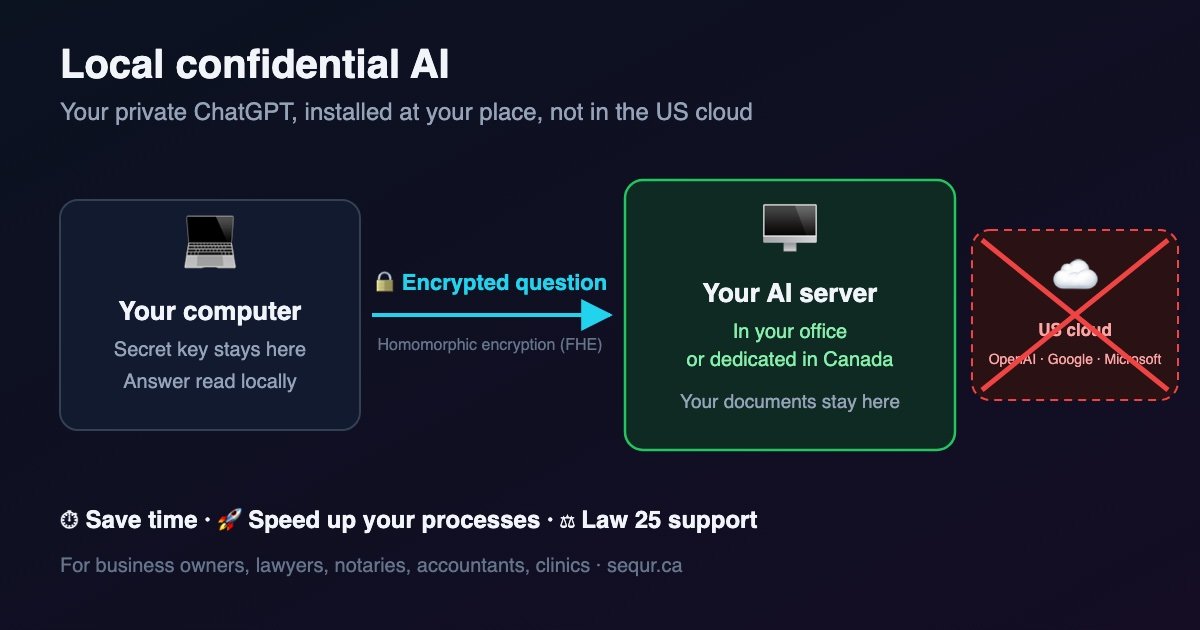
Your data leaves Canada without you noticing
When an employee pastes a contract into ChatGPT to get a summary, the document is sent to OpenAI servers in the United States. Depending on account settings it can be used to improve models, and it falls under the US CLOUD Act (2018), which lets US authorities demand access to data held by a US company, even when the servers are physically in Canada.
Microsoft Azure, Google Cloud, Amazon AWS: same reality. These are US companies. An OpenAI Enterprise plan reduces the training risk but does not protect you from the CLOUD Act.
Who is exposed?
- Lawyers / notaries - pasting a client contract into ChatGPT can conflict with professional secrecy: the document goes to US servers without client consent.
- Clinics / health - consultation notes or care protocols sent outside the clinic: a risk for health information confidentiality.
- Accountants / CPAs - financial statements and tax data sent without a privacy impact assessment: a Law 25 compliance issue in Quebec.
- HR / management - employee files analysed with ChatGPT = personal information communicated outside Quebec, which requires a privacy impact assessment (Law 25, s. 17).
Why a VPN is not enough
A VPN hides your IP address, not your content. In Enterprise mode, OpenAI promises not to train on your data, but the data still goes through their servers in clear text during processing. The real fix: keep the AI on a server you control, and keep the questions encrypted.